
What is Income?
Beginner investors often feel uncertain when starting out. Many focus too heavily on short-term price swings, assuming that frequent trading is the only way to generate returns. However, the core philosophy of Income Investing centers on holding specific assets to seek opportunities for interest, dividends, or distributions that meet ongoing cash flow needs. As a key component of asset allocation, Income Investing enables investors to access diverse income streams while enhancing overall portfolio diversification.

What is Income Investing?
Income Investing refers to an investment approach that seeks to generate income through holding assets over time, typically in the form of interest or dividend distributions paid periodically, such as monthly or annually. Common sources of income include:
- Bond coupons
- Stock dividends
- Rental yields from Real Estate Investment Trusts (REITs)
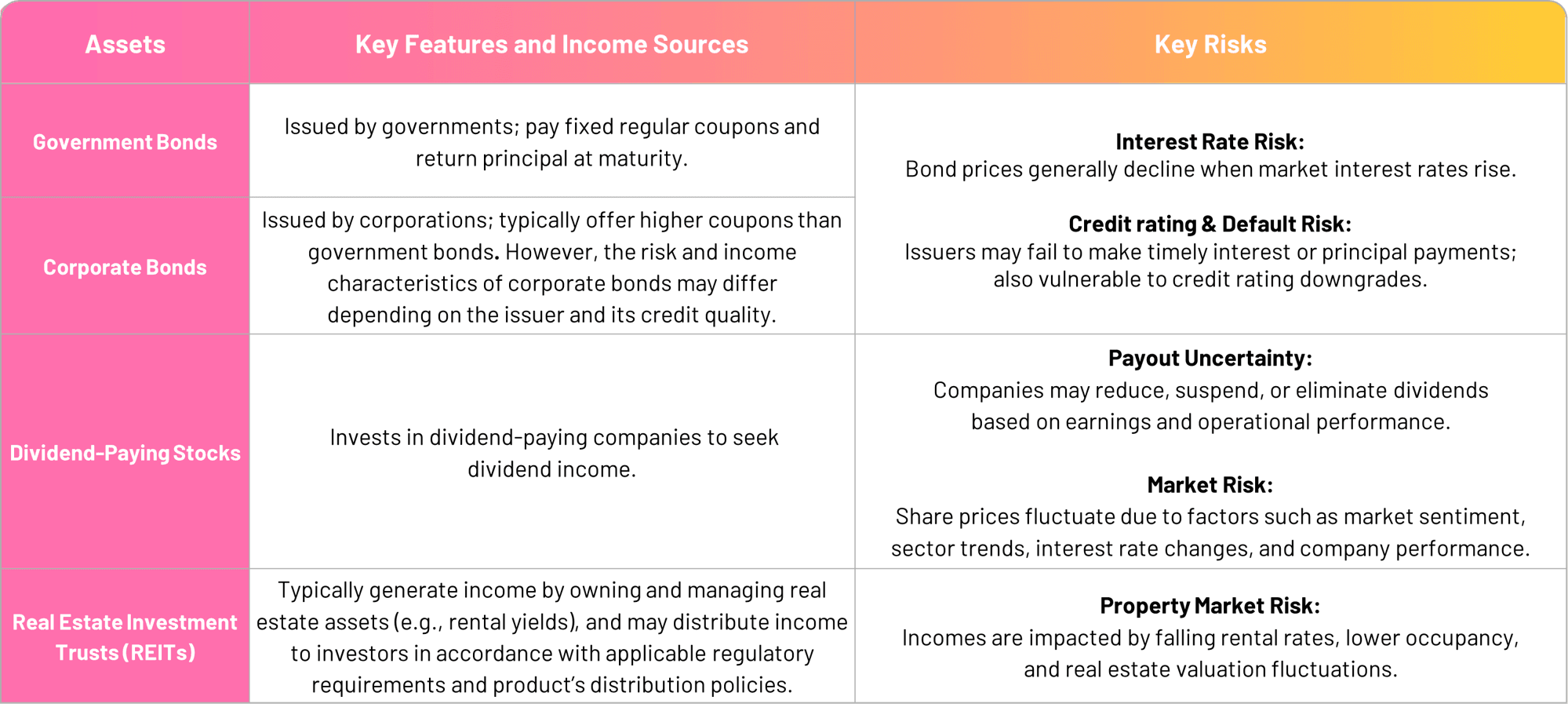
What are the common income-generating assets?
Generally, higher yields are often associated with higher risks. Each asset class features unique income drivers and associated risk factors:
What is an Income Fund?
An Income Fund typically feature three key characteristics:

Allocation to Income-Generating Assets
The fund primarily invests in assets that may provide regular payouts (such as bonds and dividend-paying stocks) with the objective of seeking interest or dividend income.

Diversified Portfolio Allocation
Different assets follow varying payout schedules and cycles. Investing across a diversified portfolio helps balance payout cycles and support a relatively steady source of cash flow.

Distribution Share Classes
Some funds offer distribution share classes aimed to pay out income on a regular basis. However, dividend payments are not guaranteed, and the payout frequency and amount may vary depending on fund performance and other relevant circumstances.
Key Principles for Seeking Income
Investor demand for income funds remains strong amid market volatility, and a wide range of income funds is available in the market. However, it is essential to keep the following three principles in mind while seeking income:

Look Beyond High Yields
A high distribution yield does not equate to a high total return. When a fund pays out dividends, its Net Asset Value (NAV) is typically reduced accordingly. Therefore, evaluating fund performance requires considering both NAV movements and total returns inclusive of distributed dividends. If the distribution yield is set too high, the fund may need to distribute dividends from capital during downturns, eroding its NAV and resulting in a scenario where yield gains are offset by capital loss.

Assess Your Risk Profile
Income and risk go hand in hand. Generally, higher potential yields are accompanied by higher risks; conversely, moderating your income expectations may help lower overall portfolio risk and enhance stability.

Put Your Income to Work
Holding dividend payouts in cash for extended periods may erode its purchasing power. Once you accumulate a meaningful payout balance, you may review prevailing market conditions and consider whether reinvesting the proceeds is appropriate in light of keeping your long-term financial goal on track.
Disclaimer
The information provided is for reference only and does not constitute any investment advice. Investment involves risk. The price of an investment fund unit may go up as well as down and investment funds may become valueless. Past performance is not indicative of future performance. Before making any investment decisions, you should consider your own financial situation, investment objectives and experience, risk acceptance and capacity, and carefully read the relevant fund offering documents to understand the nature and risks of the relevant products.