
Explore new options for cash allocation—starting with understanding Short-term Bond Funds.
Market volatility persists, and many investors have chosen to hold cash temporarily and adopt a wait-and-see approach. However, in an environment where interest rates and macroeconomic factors continue to evolve, holding cash alone may not be sufficient to meet long-term needs for capital growth or preservation. As a relatively low-volatility asset class, short-term bond funds may serve as a potential option for gradually transitioning from cash into the investment market.
Why consider Short-term Bond Funds?
1. Relatively low sensitivity to interest rate
Short-term Bond Funds primarily invest in debt instruments with shorter maturities. As a result, their prices are generally less sensitive to changes in interest rates. Compared with medium- to Long-term Bonds, they may help mitigate the impact of interest rate fluctuations.
2. Potential source of stable income
At current interest rate levels, Short-term Bonds typically offer a certain level of coupon income. While income distributions are not guaranteed, they may provide a more attractive source of returns compared with cash deposits.
3. Relatively low volatility
In general, Short-term Bond funds tend to exhibit lower price volatility than equities or longer-duration bonds. Data shows that over the past year, the average price fluctuation of Short-term Bond Funds sold in Hong Kong was around 1.48%.
4. High liquidity
These funds typically offer relatively high liquidity, allowing investors to reallocate funds when needed.
Recent views from leading fund houses on Short-term Bonds:
1. Aim at generating returns with lower interest rate sensitivity
JPM notes that short-term bonds provide income while having lower interest rate sensitivity than medium- to long-term bonds. As the yield curve gradually normalizes, short-term bonds currently offer attractive yield levels and can help manage overall portfolio volatility in fluctuating market conditions. Their relatively higher yields may also provide a cushion for investment portfolios.
Invesco adds that returns from shorter-duration investment-grade bonds are primarily driven by interest income and are supported by their shorter-duration structure.
2. Offering a more attractive source of returns
Schroders highlights that short-term bonds combine higher yield levels with lower interest rate risk, making them a relatively balanced allocation option in the current environment. Compared with cash, they may offer more attractive returns and can help, to some extent, address the impact of inflation on purchasing power.
BlackRock notes that as markets increasingly recognize that inflation may remain elevated, Short-term Bonds appear relatively more attractive.
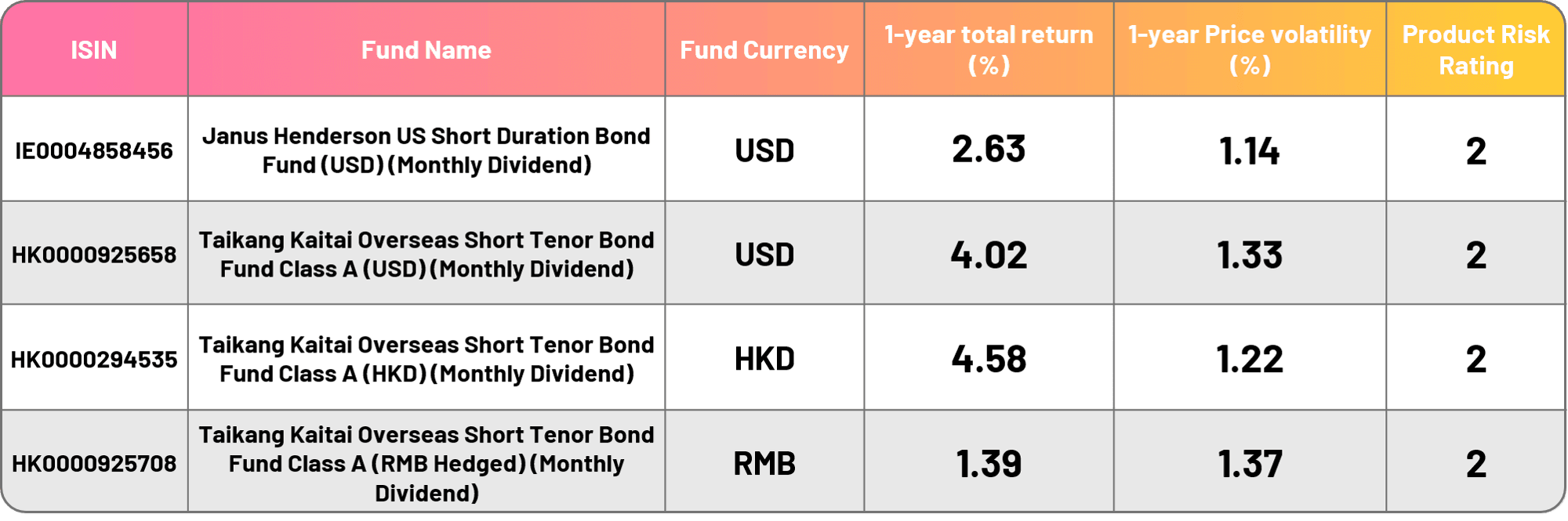
Featured Funds Service: Short-term Bond Funds at a glance
----------
Sources:
- JPM: Short Duration Fixed Income: Moving Beyond Cash, 2026
- Schroders: Shift parked cash into short-dated bonds,2026
- Invesco: 2026 Midyear Investment Outlook – Asia Fixed Income: Investment Grade 2026
- Blackrock: global-weekly-commentary#asset-class-views
Note:
- Information is provided by fund houses and Morningstar Asia Limited.
- Price volatility is expressed as the standard deviation of fund price changes. Please refer to the fund’s offering documents for details. Data is as of 31 Aug 2026.
- Investment involves risks The price of an investment fund unit may go up as well as down and the investment funds may become valueless. Part of your investment may not be able to liquidate immediately under certain market situation. Past performance is not indicative of future results. This material is for information purposes only and does not constitute investment advice. It is for reference only and does not represent an offer, solicitation, recommendation, opinion, or guarantee to buy, sell, subscribe to, or transact in any investment product or service. Investment products or services are not equivalent to, and should not be regarded as substitutes for, time deposits.
- Janus Henderson US Short-Term Bond Fund (USD) (Monthly Distribution) annual performance: 2025: 5.59%, 2024: 4.69%, 2023: 4.60%, 2022: -5.75%, 2021: -0.45%. Taikang Overseas Short-Term Bond Fund Class A (HKD) (Monthly Distribution) annual performance: 2025: 5.87%, 2024: 7.16%, 2023: 10.37%, 2022: 1.79%, 2021: -0.18%. Taikang Overseas Short-Term Bond Fund Class A (USD) (Monthly Distribution), inception date: 30 Jun 2023, annual performance: 2025: 5.64%, 2024: 7.78%. Taikang Overseas Short-Term Bond Fund Class A (RMB Hedged) (Monthly Distribution), inception date: 17 Sep 2024, annual performance: 2025: 3.38%;
- Dividend yield is not guaranteed and may be paid out from capital.
Disclaimer
This document is for general information only. The information or opinion herein is not to be construed as professional investment advice or any offer, solicitation, recommendation, comment or any guarantee to the purchase or sale of any investment products or services. This document is for general evaluation only. It does not take into account the specific investment objectives, financial situation or particular needs of any particular person or class of persons and it has not been prepared for any particular person or class of persons. The investment products or services mentioned in this webpage are not equivalent to, nor should it be treated as a substitute for, time deposit, and are not protected by the Deposit Protection Scheme in Hong Kong.
The information or opinion presented has been developed internally and/or taken from sources (including but not limited to information providers and fund houses) believed to be reliable by WeLab Bank, but WeLab Bank makes no warranties or representation as to the accuracy, correctness, reliabilities or otherwise with respect to such information or opinion, and assume no responsibility for any omissions or errors in the content of this document. WeLab Bank does not take responsibility for nor does WeLab Bank endorse such information or opinion.
Investment involves risks. The price of an investment fund unit may go up as well as down and the investment funds may become valueless. Past performance is not indicative of future results. WeLab Bank makes no representation or warranty regarding future performance. Any forecast contained herein as to likely future movements in interest rates, foreign exchange rates or market prices or likely future events or occurrences constitutes an opinion only and is not indicative of actual future movements in interest rates, foreign exchange rates or market prices or actual future events or occurrences (as the case may be).
You should not make any investment decision purely based on this document. Before making any investment decisions, you should consider your own financial situation, investment objectives and experiences, risk acceptance and ability to understand the nature and risks of the relevant product(s). WeLab Bank accepts no liability for any direct, special, indirect, consequential, incidental damages or other loss or damages of any kind arising from any use of or reliance on the information or opinion herein. You should seek advice from independent financial adviser if needed.
WeLab Bank is an authorised institution under Part IV of the Banking Ordinance and a registered institution under the Securities and Futures Ordinance (CE Number: BOJ558) to conduct Type 1 (dealing in securities) and Type 4 (advising on securities) regulated activities.
This document is issued by WeLab Bank. The contents of this document have not been reviewed by the Securities and Futures Commission in Hong Kong.